
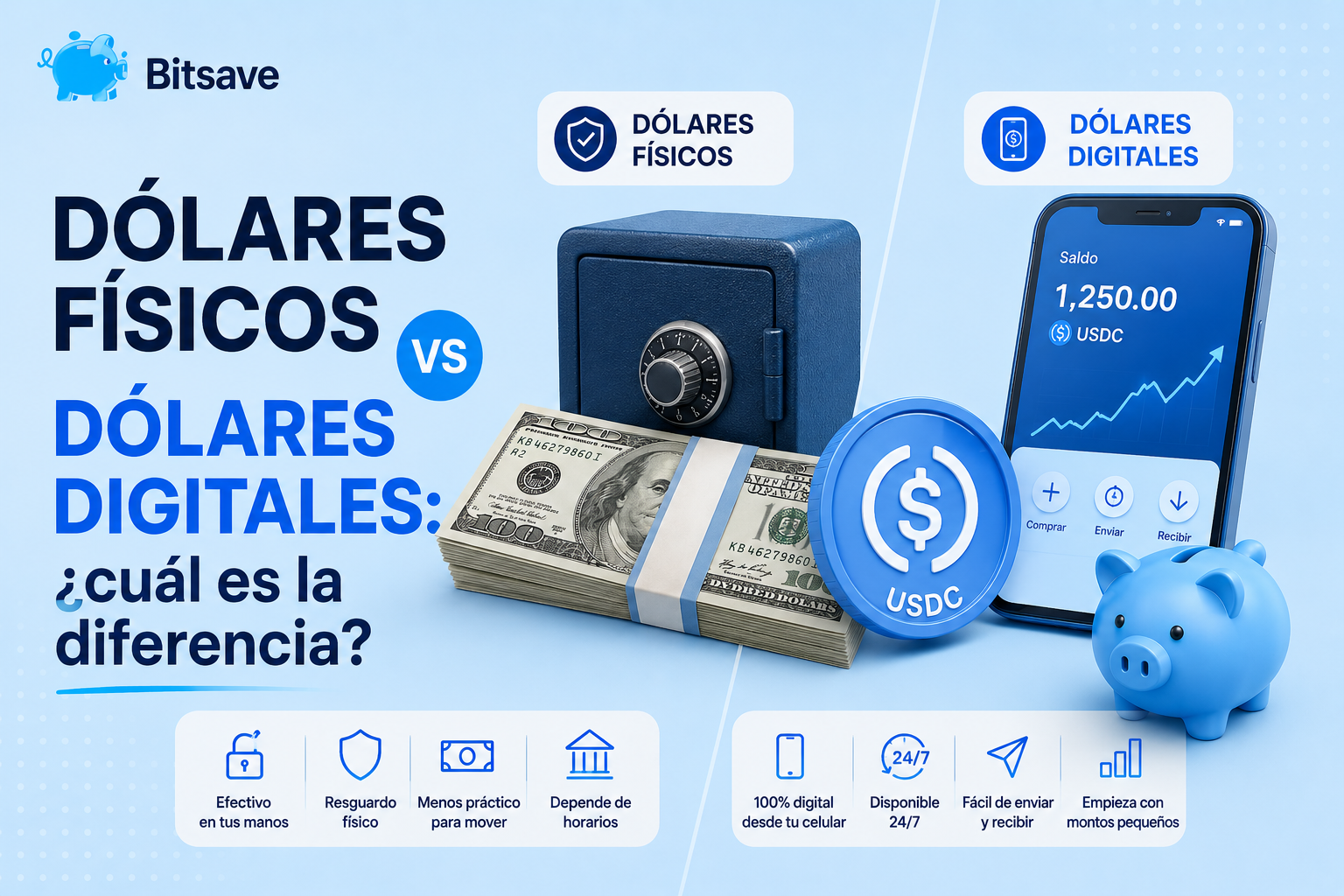
What are physical dollars?
They are traditional banknotes issued by the United States.
For example:
$1 bills
$20 bills
$100 bills
These are the dollars that you can keep in cash, in a safe or in a dollar bank account.
What are digital dollars?
Digital dollars are digital assets designed to maintain a value close to the US dollar.
For example:
USDC
USDT
Its objective is for each unit to maintain an approximate value of 1 dollar.
👉What is a stablecoin and why do millions use it?
The main similarity
Both physical and digital dollars seek to give you exposure to the value of the US dollar.
That is why many people use them to:
Save
Protect yourself from devaluation
Diversify your finances
Difference
Physical dollars
To obtain them you normally need:
Go to an exchange house
Buy cash
Or have a bank account in dollars
Digital dollars
You can purchase them directly from a compatible app.
In many cases, without leaving home.
👉How to buy digital dollars on Bitsave using SPEI
Difference
Physical dollars
They need a safe place to hide.
For example:
Safe
Bank
Personal protection
Digital dollars
They are managed from digital platforms and financial applications.
They do not take up physical space.
Difference
Physical dollars
Sending cash to another city or country can be complicated.
Digital dollars
They can be transferred digitally between users.
That is why many people use them to:
Payments
Remittances
International transfers
Difference
Physical dollars
They depend on you having access to cash.
Digital dollars
They can be managed from an application 24 hours a day.
Difference
Physical dollars
Sometimes you need to buy relatively large amounts to make the exchange convenient.
Digital dollars
Many platforms allow you to start with small amounts.
For example:
$250 MXN
$500 MXN
$1,000 MXN
And build your savings little by little.
Which is safer?
There is no universal answer.
Both have advantages and risks.
Physical dollars may face risks such as:
Loss
Heist
Deterioration
Digital dollars depend on:
The platform used
Security measures
Account protection
Which one do the new generations use the most?
More and more people are using digital solutions because they offer:
Ease of access
Administration from cell phone
Fast transfers
Purchases from small amounts
However, many people still prefer to keep a combination of both.
And what does Bitsave have to do with it?
Bitsave allows access to digital dollars from a single application.
Can:
Buy digital dollars
Schedule automatic purchases
Manage your savings
Withdraw to Mexican pesos
Everything from your cell phone.
Conclusion
Physical dollars and digital dollars serve the same goal for many people: maintain exposure to the US dollar.
The difference is how you get them, how you manage them, and how easy it is to move them.
For those seeking convenience, mobile access and ease of use, digital dollars have become an increasingly popular alternative.
References
[1] Federal Reserve – U.S. Currency Information
https://www.federalreserve.gov
[2] Circle – USDC Overview
https://www.circle.com/usdc
[3] Chainalysis – Global Crypto Adoption Report
https://www.chainalysis.com