
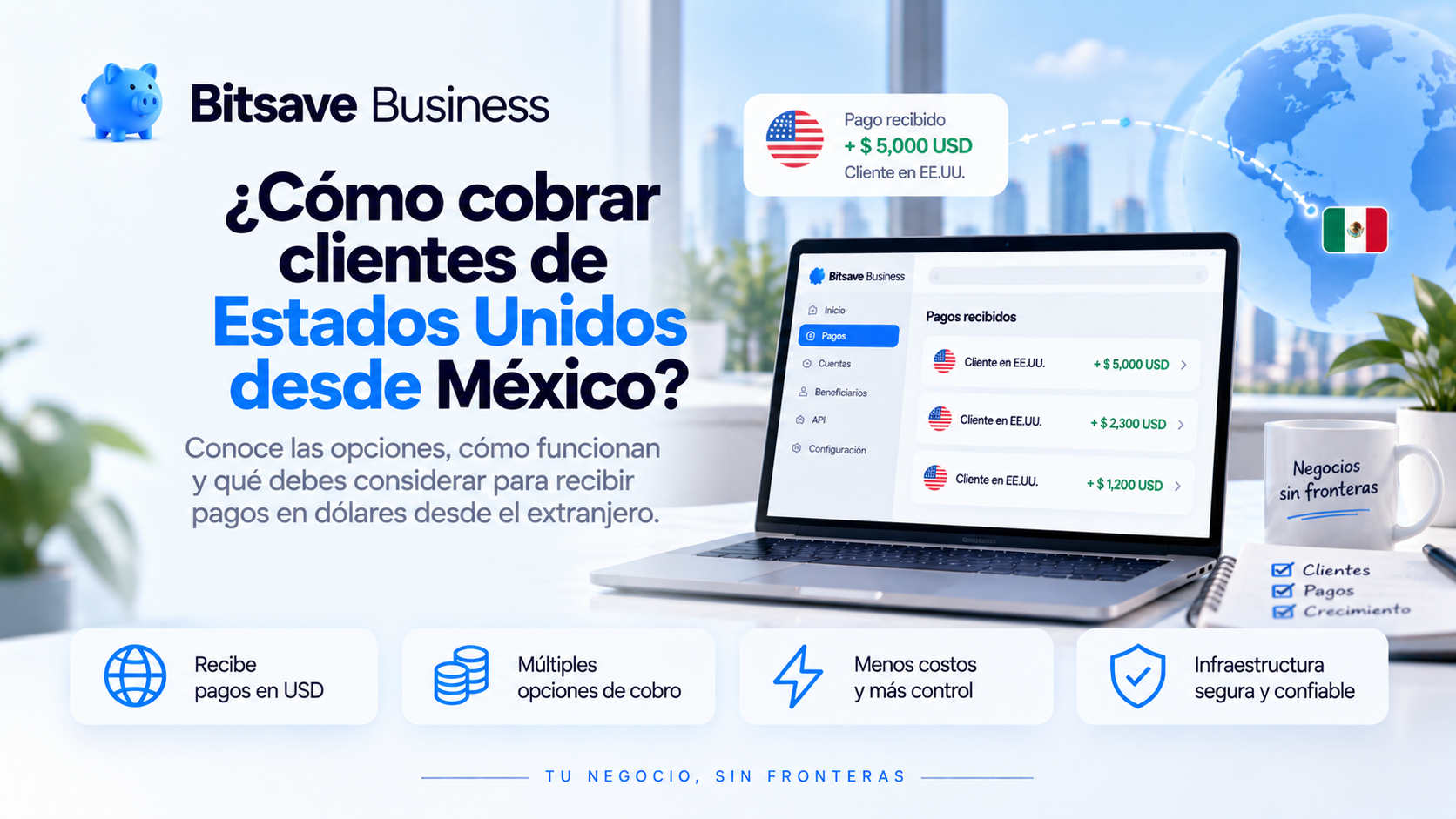
Why can it be difficult to receive payments from the United States?
When a Mexican company receives money from another country, the payment may involve different currencies, banks and intermediaries.
For example:
Customer in the United States → dollars (USD) → international transfer → conversion → Mexican pesos (MXN).
Even if for your client it is simply sending money, there may be several processes behind it.
This can generate:
Commissions for international transfers.
Conversion costs from dollars to pesos.
Processing times.
Banking intermediaries.
Difficulties in tracking payments.
For a company that charges international clients every month, these factors can affect your costs and operation.
Option 1: international bank transfer
One of the most traditional ways to receive payments from the United States is through a bank transfer.
Your customer uses the bank details you provide and requests the shipment from their financial institution.
Depending on the banks involved, the transfer may use the SWIFT network and go through intermediary banks.
What should you consider?
Shipping and receiving commissions.
The exchange rate used.
Possible intermediary charges.
Processing times.
The currency in which you will finally receive the money.
Bank transfers can be a good option, but they are not always the most convenient alternative for all companies.
Option 2: multi-currency accounts
Another alternative is to use a multi-currency account.
A multicurrency account allows you to manage balances in different currencies from the same financial infrastructure.
For example:
USD — US dollars
MXN — Mexican pesos
EUR — euros
This can be especially useful for companies that work with customers and suppliers in different countries.
Imagine you receive $5,000 USD from an American client.
With a multi-currency solution that allows you to maintain balances in dollars, you could keep that money in USD and decide later when to convert it to Mexican pesos.
You don't necessarily have to convert all your international income immediately.
The availability of accounts, currencies and receiving methods depends on the provider used.
Option 3: Receive payments through local payment infrastructure
Although the payment is international, some platforms use local payment systems to facilitate part of the process.
For example:
In the United States there isACH, an infrastructure used for certain domestic banking payments.
In Mexico there isSPEI, which allows electronic transfers in Mexican pesos.
Financial infrastructure companies can connect different systems to facilitate payments between countries.
In this way, some international payments can be processed through a combination of local networks and specialized providers, rather than relying exclusively on a traditional international bank transfer.
Option 4: receive digital dollars
Another alternative is digital dollars, such as USDC.
USDC is a stablecoin designed to maintain a value close to one US dollar.
Unlike a bank transfer, USDC can be sent between compatible wallets using blockchain.
This allows digital assets to be moved internationally via networks that operate 24/7.
A simple example
Imagine that your company has a client in the United States who needs to pay an invoice of $2,000 USD.
If both parties can trade digital assets and meet the corresponding requirements, the client could send the USDC equivalent to a compatible enterprise wallet.
Afterwards, your company could:
Maintain digital assets.
Use them for compatible operations.
Convert them to Mexican pesos through a provider that offers that function.
It is important to consider conversion costs, network fees, and the risks inherent to digital assets.
What is the difference between these options?
Method | How it works | What you should check |
|---|---|---|
Bank transfer | Money is sent between financial institutions | Commissions, intermediaries and times |
Multicurrency account | Allows you to manage balances in different currencies | Currencies, requirements and costs |
Local payments infrastructure | Connect home systems through providers | Coverage, availability and conversion |
Digital dollars | Use blockchain and compatible wallets | Custody, network, conversion and risks |
There is no option that is always the cheapest or the fastest.
It all depends on the country, the provider, the amount and the currency in which you need to receive the money.
The exchange rate can make a big difference
This is one of the most important aspects when receiving international payments.
Imagine that your company charges$5,000 USD.
Suppose you have two alternatives:
Option A:1 USD = $18.00 MXN.
Option B:1 USD = $17.70 MXN.
In the first case you would receive, before commissions:
$90,000 MXN.
In the second:
$88,500 MXN.
The difference would be$1,500 MXN.
And we are talking about exactly the same payment of $5,000 USD.
This example is illustrative, but shows why it is important to review the exchange rate and not just the advertised fee.
Is it better to receive dollars or convert them immediately to pesos?
It depends on the needs of your company.
If you have expenses in Mexico, you will probably need pesos to pay payroll, local suppliers or services.
But if you also pay suppliers in the United States or Europe, keeping some of your income in other currencies could help you manage your international operations.
For example:
A Mexican company receives $10,000 USD from foreign clients.
That same month you need to pay $3,000 USD to a US supplier.
If you have an infrastructure that allows you to maintain and use USD balances, you may be able to avoid certain unnecessary conversions, depending on the terms of service.
What happens if you receive international payments every month?
When a company begins to work regularly with foreign clients, receiving payments stops being an occasional operation.
It becomes part of your financial operation.
That is why it is important to have tools that allow:
Check international income.
Manage different currencies.
Review conversion costs.
Follow up on operations.
Reconcile payments and invoices.
Integrate information with other business systems.
This is where financial infrastructure can make a difference.
How does Bitsave Business come in?
Bitsave Business is designed to help businesses that need to add financial and digital asset infrastructure without developing all the components from scratch.
Its proposal includes infrastructure solutions that can be integrated through APIs, facilitating the development of financial products and services.
Bitsave's capabilities and product lines include:
International payments infrastructure.
Multicurrency solutions.
Access to digital assets like USDC.
Wallets and administration tools.
Integration through APIs.
The availability of each feature depends on the country, product and applicable commercial conditions.
The idea is simple: your company focuses on its customers and Bitsave helps with the financial infrastructure behind it.
For which companies can it be useful?
Marketing and advertising agencies
Mexican companies that work with American brands and receive monthly payments for their services.
software companies
Startups and developers that sell technology to international clients.
Consultants
Companies that provide professional services to clients in other countries.
International trade business
Companies that sell products outside of Mexico and need to manage collections and payments in different currencies.
Financial platforms
Fintechs that seek to integrate international payment solutions and digital assets through APIs.
What should you check before receiving your first payment?
Before choosing a solution to collect from the United States, consider:
1. Receiving currency:Will you receive dollars or Mexican pesos?
2. Total cost:How much do they charge you to receive and convert money?
3. Exchange rate:What rate will they use if you need to convert to MXN?
4. Time:When will the funds be available?
5. Documentation:What data, verifications and receipts does your company need?
6. Security:What institution or provider processes and safeguards the funds?
Also remember that receiving money from abroad may generate tax and billing obligations in Mexico. It is advisable to review with your accountant the requirements applicable to each operation.
Conclusion
Collecting US customers from Mexico no longer means relying solely on an international bank transfer.
Today there are alternatives such as multi-currency accounts, local payment networks and digital dollars that can facilitate different types of operations.
For a company, the most important thing is to understand:
How much money you will actually receive, in what currency, how long it will take and what costs the operation will have.
Because when your clients are in different parts of the world, you need a financial infrastructure that can accompany the growth of your business.
With Bitsave Business, businesses can explore new ways to integrate financial services and operate internationally.