
First: what is SWIFT?
SWIFT is a financial messaging network used by banks and financial institutions to securely exchange payment instructions.
When a company makes an international transfer, banks can use SWIFT to communicate and coordinate the operation.
However,SWIFT is not the system that physically moves money. Settlement occurs through connected accounts and financial systems.
Depending on the country, currencies and banks involved, an international transfer may require intermediaries.
And that can generate additional costs or time.
Why can receiving international payments be complicated?
Imagine that you have a marketing agency in Mexico.
You work with three clients:
A company in the United States that pays you in dollars.
A company in Spain that pays you in euros.
A company in Chile that pays you in Chilean pesos.
Although everyone is paying for your services, receiving that money can involve different processes.
For example:
United States → USD → intermediary bank → Mexico
Spain → EUR → conversion → Mexico
Chile → CLP → conversion → Mexico
Additionally, there may be fees, exchange rate differences, and processing times.
For a company that constantly receives international payments, managing all these movements can become a complicated task.
What alternatives exist to receive payments without using SWIFT?
Today there are different infrastructures that can facilitate international payments.
1. Multicurrency accounts
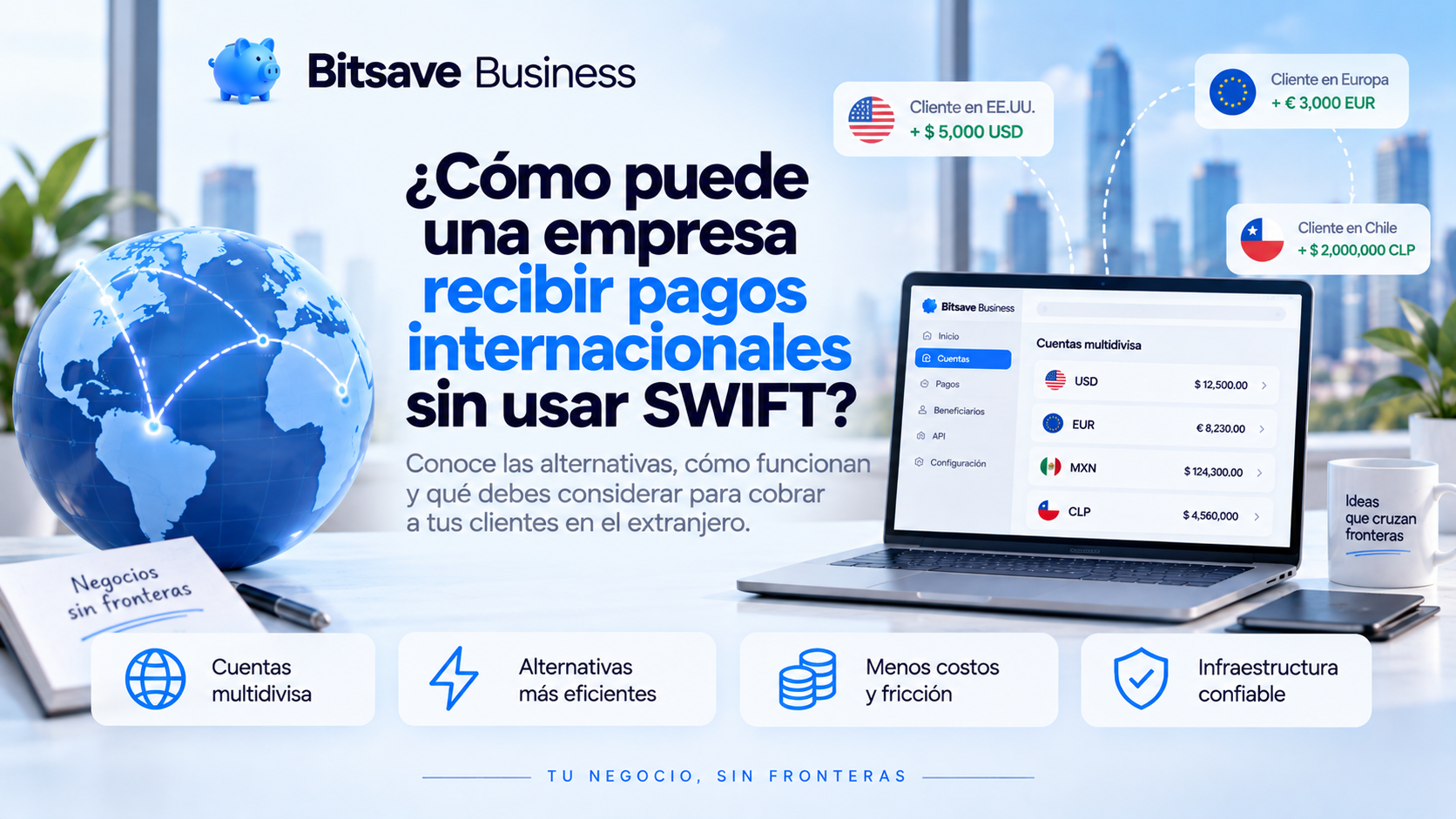
A multicurrency account allows you to manage balances in different currencies from the same infrastructure.
For example:
Mexican pesos (MXN).
United States dollars (USD).
Euros (EUR).
This can be useful for companies that charge foreign customers and need to make payments in different currencies.
Imagine that your company receives $5,000 USD from an American client.
If you have a compatible multi-currency solution, you could keep those dollars and decide later if you need to convert them to pesos or use them for another payment.
The advantage is that you don't necessarily have to convert each income immediately to your local currency.
The availability of currencies, bank details and reception methods depends on each provider.
2. Local payment networks
Another alternative is to use domestic payment infrastructure connected through international providers.
For example, there are systems such as:
SPEI in Mexico:allows you to make electronic transfers in Mexican pesos.
ACH in the United States:Allows you to process certain domestic bank payments.
SEPA in Europe:facilitates transfers in euros within its coverage area.
Separately, these systems are mainly local or regional.
But a financial infrastructure that has connections in different countries can use them to build cross-border payment services.
Thus, some international payments can be completed without each individual transfer having to travel through a traditional chain of correspondent banks using SWIFT.
3. Digital dollars and stablecoins
Digital dollars, like USDC, offer another alternative.
USDC is a stablecoin designed to maintain a value close to the US dollar.
Unlike a traditional bank transfer, digital assets can be sent using supported blockchain networks.
These networks operate 24 hours a day, 7 days a week.
For example:
A company receives 2,000 USDC from an international customer.
Depending on the services available, you could hold those digital assets or later convert them to a local currency.
This can facilitate certain international payments, especially when both parties use compatible infrastructure.
However, fees, custody, local currency conversion and applicable legal obligations must also be considered.
SWIFT vs digital alternatives: what's the difference?
Feature | Bank transfer via SWIFT | Digital alternatives |
|---|---|---|
Infrastructure | Bank messaging and correspondent banks | Local networks, payment providers or blockchain |
Schedules | They depend on the systems involved | Blockchain operates 24/7; other systems have their own schedules |
Intermediaries | Several banks can participate | Depends on the provider and the route |
Coins | It depends on the banks | Depends on platform and connections |
Commissions | Banking, intermediaries and currency exchange | Provider, network and conversion commissions |
Time | Variable depending on banks and countries | Variable depending on method and destination |
There is no alternative that is always faster or cheaper.
The important thing is to compare the total cost, the availability time and the currency that your company finally receives.
An example: receiving $5,000 USD from the United States
Imagine that your Mexican company provides software development services to a US client.
At the end of the project, you issue an invoice for $5,000 USD.
Option 1: international bank transfer
Your client requests payment through their bank.
The transfer may involve intermediary institutions and a currency conversion.
Finally, your company receives the funds according to the conditions of the receiving bank.
Option 2: international payments infrastructure
Your company uses a provider that offers international receiving methods.
The customer pays using a compatible route and the infrastructure processes the payment.
Depending on the service contracted, your company could receive payment in dollars or convert it to Mexican pesos.
Option 3: digital dollars
If both companies can use digital assets and meet the corresponding requirements, the customer could send USDC to a compatible enterprise wallet.
Then, your company can maintain them or convert them through a provider that allows this operation.
The three alternatives seek to solve the same problem: receiving payment from an international client.
What changes is the infrastructure behind it.
What happens if you receive payments in different currencies?
This is where multi-currency accounts can be especially useful.
Imagine that your company receives:
$5,000 USD from the United States.
€3,000 EUR from Spain.
$2,000 USD from a client in Colombia.
Instead of managing each deposit through completely separate processes, a multi-currency infrastructure can help centralize information and manage different balances.
This makes it easier to track international revenues and plan payments to suppliers.
What should a company review before choosing?
Before hiring a solution to receive international payments, it is important to evaluate:
1. Available countries
From which countries can you receive money?
2. Supported currencies
Can you receive USD, EUR and other currencies?
3. Total costs
Are there reception, conversion or withdrawal fees?
4. Processing times
How long does it take for the money to be available?
5. Security and compliance
What business verifications are required and which institutions are involved?
6. Technological integration
Can you connect payments with your administrative or financial systems?
How does Bitsave Business come in?
Bitsave Business seeks to simplify the financial infrastructure that companies need to operate internationally.
Its proposal includes digital asset infrastructure and financial solutions that can be integrated through APIs.
This allows companies and platforms to develop financial experiences without having to build all the technological components from scratch.
Bitsave's capabilities and infrastructure lines include:
Multicurrency accounts.
Infrastructure for international payments.
Integration through APIs.
Access to digital dollars.
Wallets and services related to digital assets.
Connections with compatible payment methods.
The availability of each functionality depends on the corresponding product, country and commercial conditions.
The idea is simple:
Your company focuses on growth. Bitsave helps with the financial infrastructure behind it.
For which companies can it be useful?
These solutions can be interesting for different businesses.
Agencies and consultants
Companies that work with clients in the United States or Europe and need to charge for international services.
Startups and technology companies
Businesses that receive income from different markets and seek to manage multiple currencies.
Exporting companies
Companies that sell products internationally and need to receive payments from abroad.
Fintechs and financial platforms
Companies that want to integrate international payments, accounts or digital assets into their own applications through APIs.
The future of international payments
For a long time, receiving money from another country meant relying primarily on banks and their international systems.
Today there are more alternatives.
Multi-currency accounts, internationally connected local systems and blockchain networks are expanding possibilities for companies operating in different countries.
It doesn't mean that SWIFT is going to disappear.
It means that businesses can now choose between different infrastructures depending on their needs.
Conclusion
Receiving international payments no longer has to rely exclusively on a traditional bank transfer using SWIFT.
Today there are alternatives that allow the use of multi-currency accounts, local payment networks and digital assets to facilitate certain international flows.
For a company, the important thing is to understand:
How much it costs to receive the money, what currency it will arrive in, how long it will take and what infrastructure it needs.
Because when your business works with customers around the world, your payments need to work globally too.
With Bitsave Business, financial infrastructure can adapt to the needs of companies seeking to operate beyond their borders.
👉Discover Bitsave Business and learn about its solutions for companies