
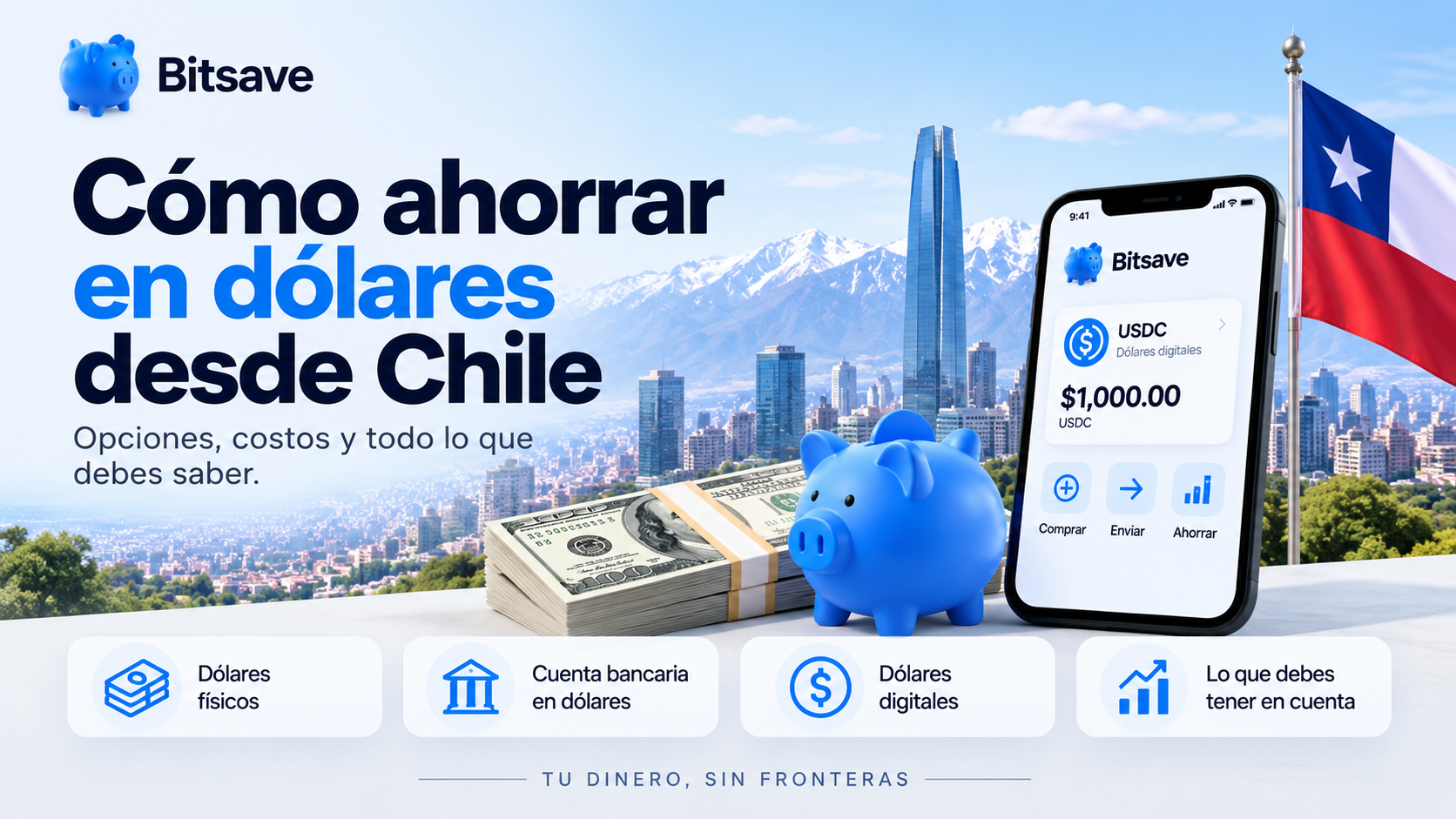
Why do some people in Chile save in dollars?
Most of our daily expenses in Chile are inChilean pesos (CLP).
But the peso and the dollar constantly change value relative to each other.
That is why some people decide to keep a part of their savings linked to the dollar todiversifyand not have all your money in one currency.
This does not mean that the dollar will always rise or that it will necessarily be better than the Chilean peso. The exchange rate can move in both directions.
What options do you have to save in dollars from Chile?
There are different alternatives and not all of them work the same.
1. Buy physical dollars
The traditional option.
You can exchange Chilean pesos for dollars and keep the bills.
It's easy to understand, but you have to consider:
where to buy them
the exchange rate
where to store them
how to sell them when you want to return to pesos
Additionally, storing cash involves risks such as loss or theft.
👉Physical dollars vs digital dollars: what's the difference?
2. Have a bank account in dollars
Some banks offer dollar-denominated products.
In this case, your dollars remain within the traditional banking system.
The conditions depend on each institution, so before opening an account it is advisable to review aspects such as:
costs, requirements, available transfers and conditions to withdraw or convert the money.
3. Use digital dollars
Another alternative is thedigital dollars, like USDC.
USDC is a stablecoin designed to maintain a value close to1 US dollar.
Instead of holding physical notes, you can manage these assets digitally from a compatible platform.
What is the difference?
A simple way to look at it is this:
Physical dollars | USD bank account | Digital dollars | |
|---|---|---|---|
Where are they? | Cash | Bank | Platform/wallet |
How do you access? | Physically | Bank/app | From an app |
What do you have? | USD bills | Balance in USD | USD-pegged digital asset |
Can you split it? | Limited by tickets | Yeah | Yeah |
How do you move it? | Physically/bank | Banking system | Supported digital networks |
Does it have risks? | Yeah | Yeah | Yeah |
There is no perfect option for everyone.
The best alternative depends onWhat do you want those dollars for and when might you need them?.
Don't just look at how much it costs to buy
This point is important.
When comparing options to save dollars, it's easy to only look at:
“How much do they sell me for in a dollar?”
But you should also ask yourself:
Is there a commission?
At what exchange rate can I return to pesos?
How long does the withdrawal take?
Can I have my money when I need it?
Who safeguards my funds?
The real cost is not always only in the purchase price.
What happens if the dollar rises against the Chilean peso?
Imagine a simple example.
Suppose you have100 dollars.
Yeah:
1 USD = $900 CLP
Your $100 is approximately equivalent to:
$90,000 CLP
Now imagine that the dollar rises to:
1 USD = $950 CLP
Your same $100 would be approximately equivalent to:
$95,000 CLP
You don't have any more dollars.
You still have 100.
What changed wasits value expressed in Chilean pesos.
What if the dollar goes down?
Exactly the opposite happens.
If the dollar goes from $900 CLP to $850 CLP, your 100 dollars would go from approximately equivalent to $90,000 CLP to $85,000 CLP.
That's why save in dollarsIt does not mean that your money will always increase measured in Chilean pesos.
The exchange rate can go up or down.
Do I have to convert all my savings to dollars?
No.
In fact, you don't necessarily have to think about:
pesos OR dollars.
You can also think about:
pesos and dollars.
You can keep pesos for your daily expenses and, depending on your goals, keep another part of your savings linked to the dollar.
That's diversifying.
What if I don't want to buy all my dollars at once?
Another alternative is to do it little by little.
For example, instead of buying a large amount at once, you can periodically set aside an amount of your income to save.
This way you don't have to guess:
“Is the dollar cheap today?”
either
“Is it going up tomorrow?”
Nobody can know for sure.
👉Schedule your purchase and save recurrently in digital dollars
How safe is it to save in digital dollars?
Digital dollars also have risks.
Before using them it is advisable to understand:
what asset are you buying
who issues it
where is it kept
what platform do you use
what security measures exist
What regulation applies to the company
Not all digital dollars are the same and not all platforms work the same way.
👉How safe is it to save in digital dollars?
What does Bitsave have to do with it?
Bitsave allows you to manage digital dollars from your cell phone and seeks to make building dollar savings easy for people who are not necessarily crypto experts.
Besides,Bitsafve SpA has authorization from the Financial Market Commission (CMF) of Chile to provide Intermediation of Financial Instruments and Custody of Financial Instruments services.
This is especially relevant when comparing platforms: in addition to wondering what you can buy, it is worth understandingWho provides the service and under what framework does it operate?.
So how to choose?
Before deciding where to keep your dollars from Chile, compare at least these four things:
1. What is your money left for?
Banknotes, bank balance or a digital asset?
2. How much does it cost to get in and out.
Don't just review the purchase. Also look at the conversion back to CLP.
3. When you can have it.
Understand the withdrawal times and conditions.
4. Who is behind.
Review security, custody and regulation.
Conclusion
Today there are more ways to save in dollars from Chile than simply buying tickets.
You can use physical dollars, dollar-denominated banking products, or digital alternatives like USDC.
Each option works differently and has its own costs, risks and conditions.
That is why the question should not only be:
“Where do I buy dollars?”
But:
“Where do I want to keep my money, how much does it cost, and how easy will it be to access when I need it?”
Understanding these differences allows you to choose the alternative that best suits your objectives.