
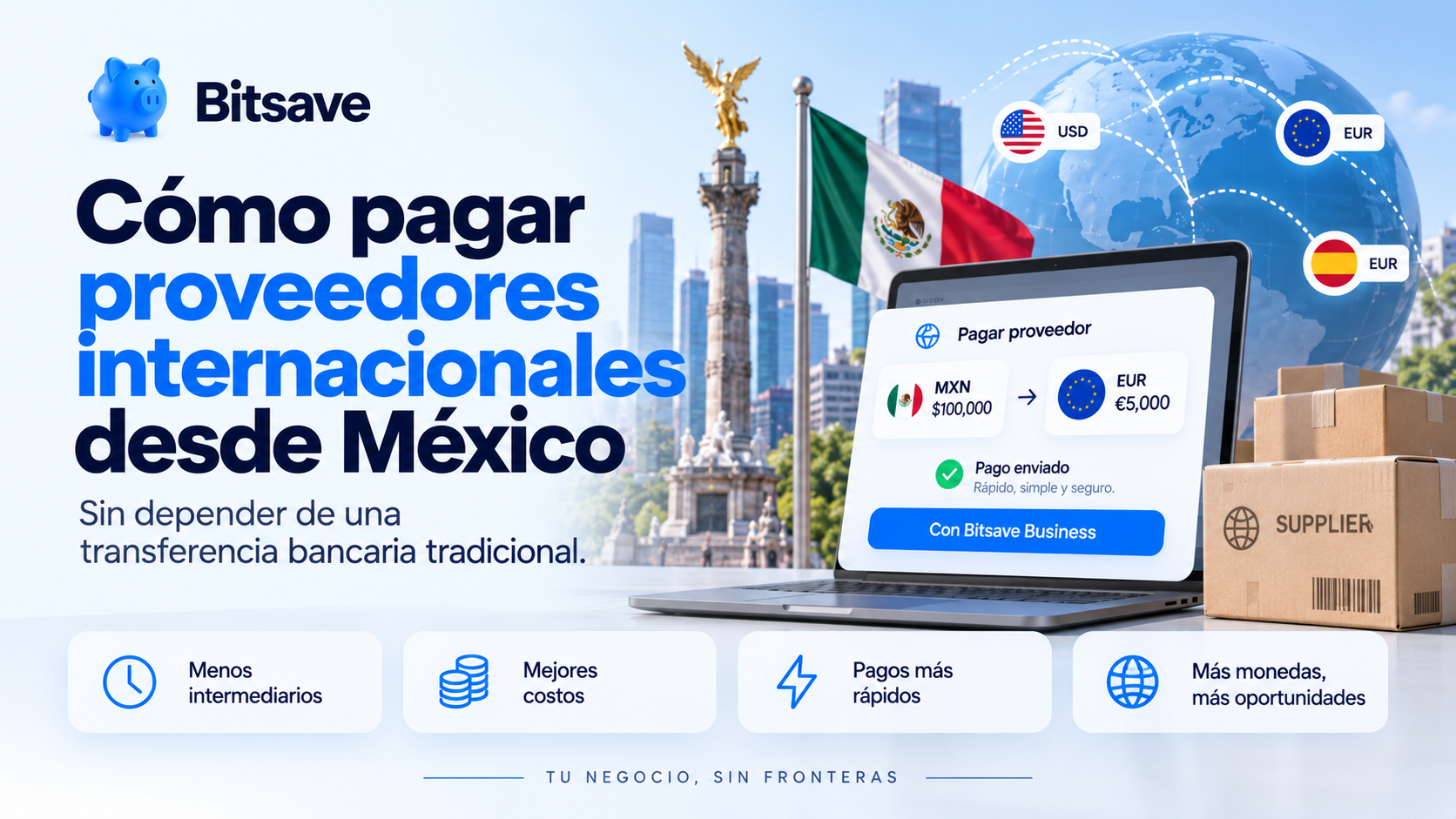
The problem is not sending money. It is moving it between countries and currencies
Imagine that your Mexican company needs to pay€5,000 to a supplier in Spain.
Your company receives income mainly in Mexican pesos, but your supplier needs euros.
The tour could look like this:
MXN → currency conversion → international transfer → EUR → provider
Even if it is a single transfer for you, different financial institutions and systems may participate behind it.
And there are three important factors:
time exchange rate costs.
How does an international bank transfer work?
Traditionally, a company asks its bank to send money to an account in another country.
Depending on the destination and the institutions involved, the payment may pass through correspondent banks or other intermediaries before reaching the beneficiary.
Additionally, the company must consider:
shipping commission
exchange rate used
Possible charges from intermediaries or the receiving bank
international banking details
processing times and days
time until funds are available
That is why the cost of an international payment is not always only the commission that appears at the beginning.
The exchange rate is also part of the cost
Suppose you need to pay€5,000.
Your company has MXN.
Before sending money you need to know:
How many pesos do I need for my supplier to receive exactly €5,000?
That's where the exchange rate comes in.
Two providers can charge a similar fee and still end up costing different amounts if they use different exchange rates.
Therefore, for a company, a more useful question than:
“How much does the transfer cost?”
is:
“How much does it cost me in total to get my supplier exactly the amount they need?”
What if you need to pay on a Friday night?
Here another important difference appears.
Banks and some traditional systems may have specific processing windows, business days, and hours.
Companies, however, do not always operate like this.
A supplier may need payment:
during the weekend
in another time zone
on a holiday
at short notice
That is why new international payment infrastructures seek to reduce dependence on a single system or rail.
What is a payment rail?
It sounds technical, but the idea is simple.
Apayment railIt is simply the infrastructure through which money travels.
For example, a bank transfer uses certain banking systems.
A local transfer may use other infrastructure.
And digital assets can use blockchain.
Different paths can serve different types of payments.
The alternative: international payments infrastructure
New financial platforms can combine different technologies to move money more efficiently.
For example:
local rails multi-currency accounts currency conversion blockchain infrastructure.
The company does not necessarily need to know what technology exists behind it.
What is important is the result:
I want to pay €5,000 to my supplier in Spain.
The infrastructure is responsible for facilitating the flow necessary for the money to reach its destination.
What is a multi-currency account?
A multicurrency account allows you to manage different currencies from the same infrastructure.
For example:
MXN — Mexican pesos
USD — US dollars
EUR — euros
This can be especially useful for companies that collect and pay internationally.
Instead of only thinking about one bank account for each need, the company can manage different balances and movements from the same experience.
And where do digital dollars come in?
Digital dollars, like USDC, add another infrastructure to move value.
Running on blockchain, they can be transferred through compatible networks that operate continuously.
This can be useful as part of certain international flows.
But it is important to understand something:
Using digital infrastructure does not mean that all international payments must be made with crypto.
In fact, the goal may be exactly the opposite.
The technology can operate behind while the company simply thinks:
“I need to pay my supplier.”
The provider should not need to understand blockchain
Imagine the payment to Spain again.
The user should not have to think:
What blockchain do I use?
What network do I need?
What stablecoin do I buy?
How do I do the conversion?
A good financial infrastructure should simplify all that.
The company indicates:
how much you want to send in what currency to whom.
And the system takes care of the rest of the available flow.
An example: Mexico → Spain
A Mexican company needs to pay a bill€5,000.
Traditional model
MXN → bank → conversion → possible intermediaries → receiving bank → EUR
Modern financial infrastructure
The flow can combine different components:
MXN → conversion → rail available → EUR → supplier
The difference is that a platform can orchestrate different infrastructures behind a single experience.
What if tomorrow the supplier is in Colombia?
The problem changes.
Now maybe you need:
MXN → COP
And the following week:
MXN → USD
And then:
USD → EUR
For a company that operates internationally, managing all of these relationships separately can quickly become an operational problem.
That's where theMulticurrency accounts and international payments infrastructureThey're starting to make a lot of sense.
How does Bitsave Business come in?
Bitsave BusinessIt is intended for companies that need financial infrastructure to operate internationally without building every piece from scratch.
The vision goes beyond simply purchasing digital assets.
Bitsave is developing infrastructure that combines:
multicurrency accounts
international payments
different payment rails
digital asset infrastructure
APIs for companies
This allows a company to incorporate financial functionalities within its own products or use infrastructure to facilitate international operations.
👉What is Bitsave Business? Financial infrastructure for companies
What if another company wants to integrate these payments into its own app?
This is where the APIs come in.
Imagine a logistics platform that has hundreds of Mexican companies paying suppliers around the world.
That platform does not necessarily want to build:
currency conversion
international infrastructure
wallets
payment systems
financial integrations
You can use third-party infrastructure using aAPI.
Thus, the user continues using the application they already know while the financial infrastructure works behind them.
The next step: say what you want to do
The evolution of this infrastructure can further simplify the experience.
Instead of manually selecting currency, network, and transfer method, a user could simply give an instruction:
“Send €200 to María in Spain.”
EITHER:
“Pay $500 USD to the supplier in Ecuador.”
A financial agent can interpret what the user wants to do and execute the corresponding flow using the infrastructure available behind it.
That's the concept behind aAI Financial AssistantAction-oriented: not only explaining how to move money, but helping to execute the operation.
What should a company compare before choosing a supplier?
Don't just look at the advertised commission.
Before moving money internationally, check:
Total cost:How much does it really come from your company?
Amount received:How much does the supplier end up receiving?
Exchange rate:what conversion is used?
Time:When will the funds be available?
Availability:What happens outside of banking hours?
Coins:What currencies can you hold, receive and send?
Integration:Can you incorporate the infrastructure into your own systems?
Compliance and security:Who operates the infrastructure and under what controls?
Conclusion
Paying international suppliers no longer has to mean relying exclusively on a traditional bank transfer.
Today there are new infrastructures that combinemulti-currency accounts, local and international payments, APIs and blockchain technologyto simplify how money moves between countries.
For a company, the goal should not be to understand every technology behind it.
It should be much simpler:
“I need to pay €5,000 to my supplier in Spain.”
The financial infrastructure should take care of the rest.